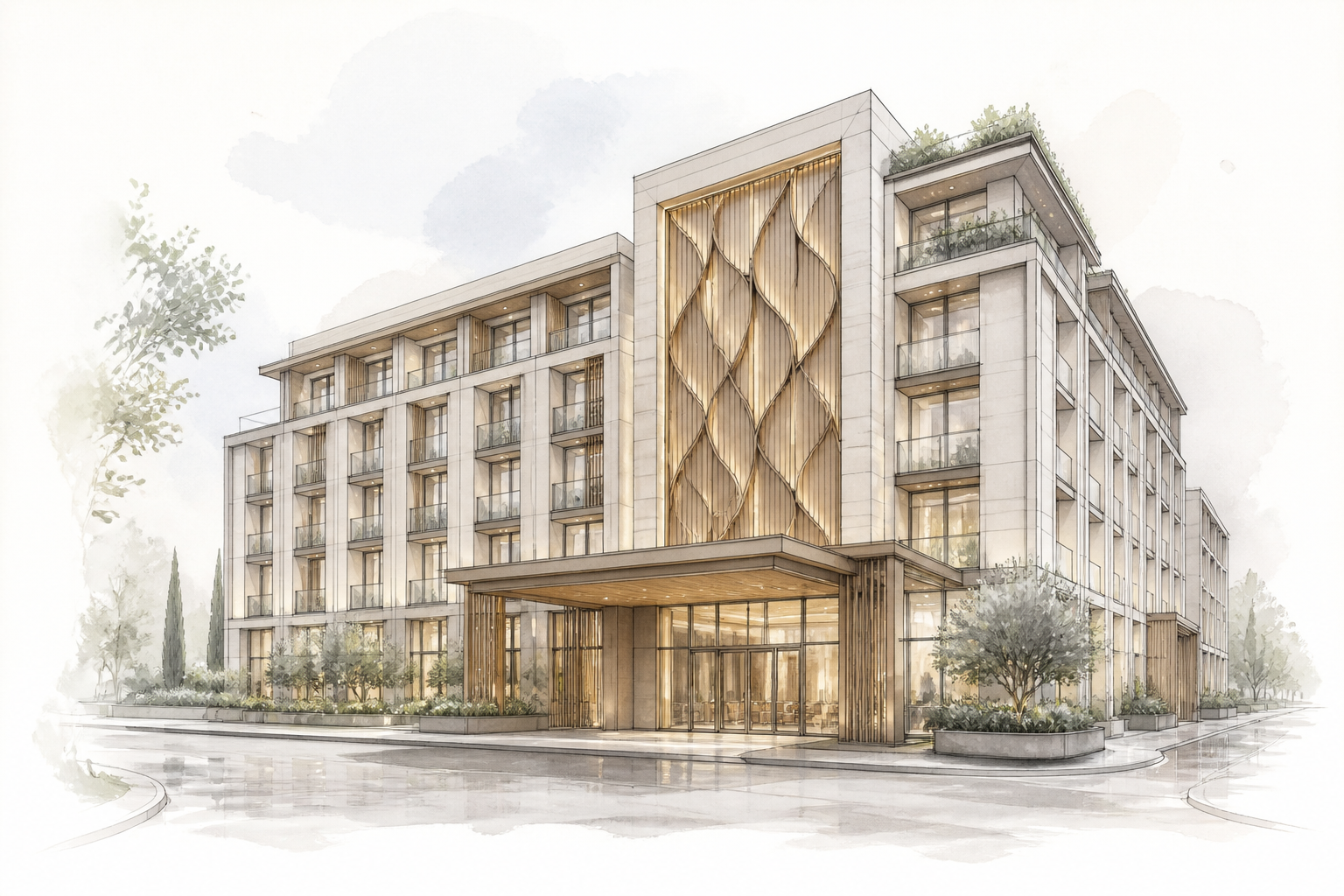
City Hotel Financial Model
Description
This is a full-service city hotel financial model, not a generic hospitality template. It is built for a property that derives revenue from multiple centers—rooms, food & beverage, meeting spaces, parking, and ancillary services. The model captures the interplay between corporate weekday demand and leisure weekend patterns, segmentation across negotiated corporate rates, BAR, OTAs, and group blocks, making it suitable for hotels in central business districts or mixed-use urban locations.
The operational logic is granular: room inventory is stratified by category and rate tier, with arrival and length-of-stay patterns influencing ancillary spend. Every F&B outlet—from the lobby bar to in-room dining—has its own driver set (seat turnover, meal period distribution, cover count). Staffing is modeled bottom-up, with department-specific ratios (rooms attendant per 10 occupied rooms, servers per 40 covers) and step-up hiring during the ramp-up period. Pre-opening and soft-opening phases are fully articulated, including capitalized pre-opening expenses, gradual occupancy ramp, and outlet phased openings.
Capital expenditures are split into construction, initial FF&E, and ongoing replacement. The model employs an FF&E reserve mechanism—not a simple P&L percent—to accumulate and disburse cash for periodic renovations without distorting free cash flow. Financing architecture can accommodate senior debt, mezzanine, and equity; the tool calculates interest during construction and fee capitalisation, and tests debt service coverage ratios. Management and incentive fee structures are integrated, reflecting standard hotel operator contracts.
The output is a fully integrated set of financial statements, a discounted cash flow valuation, and investor-level returns. A one-way sensitivity module is included to stress-test key variables. With this model, an owner-operator or developer can simulate a realistic operating trajectory and pinpoint the cash flow inflection points that generic spreadsheets miss.
Modeling specifics
- Segmented rooms model with weekday/weekend demand curves, separate ADR and occupancy per segment (corporate, leisure, group), and compression nights logic.
- F&B outlet micro-model: each outlet defined by seat count, meal period turns, average check, with cost of sales and semi-variable labor driven by covers.
- Meeting & events revenue driven by space inventory, utilization by day-part (morning, afternoon, evening), and per-attendee catering revenue.
- Full pre-opening timeline: month-by-month pre-opening staff, marketing spend, and soft operating period with gradual occupancy ramp and outlet phased openings.
- FF&E reserve as a separate balance sheet account: annual contribution (% of total revenue) and a planned 7-year replacement cycle, avoiding double-count of CapEx outflows.
- Operator management fee model: base fee (% of total revenue) + incentive fee (% of GOP) with tier thresholds and ceiling caps, plus loyalty program and brand marketing fees.
- Debt repayment sculpted to available cash flow with excess cash sweep and DSCR covenant, rather than a fixed amortization schedule.
- Multi-tier equity waterfall: distributions allocated according to preferred return, catch-up, and promote splits, with tax distribution mechanism.
- Dynamic working capital: ledgers for trade receivables (OTA, corporate), prepaid room deposits, and operating cash buffer based on days of expense.
What's included in the base version
- Room revenue segmentation (Standard, Superior, Suite; Corporate, Leisure, Group)
- F&B revenue with outlets (Restaurant, Bar, In-room dining, Mini-bar) based on covers
- Other revenue (parking, spa, misc.) — manual input
- Departmental expenses (Rooms, F&B, Other) with cost ratios
- Undistributed expenses (Admin, Sales, Maintenance, Utilities)
- Staffing plan (headcount × average salary) by department
- Pre-opening expense schedule and occupancy ramp-up profiles
- Construction and initial FF&E CapEx with straight-line depreciation
- Senior debt with equal principal amortization
- Corporate tax and property tax calculations
- Integrated three-statement model (P&L, Cash Flow, Balance Sheet)
- DCF valuation (unlevered and levered) with WACC and terminal value
- One-way sensitivity analysis on occupancy, ADR, and construction cost
Common modeling mistakes
- Modeling the hotel at stabilized occupancy from Day 1 — overstates Year-1 GOP by 20-30% and underestimates cash needed for operating losses.
- Omitting the FF&E reserve requirement or treating it as a P&L charge — EBITDA is inflated by 3-5% p.a., and the cash balance appears higher than in reality, masking future capex obligations.
- Using a single annual ADR and occupancy without weekday/weekend splits — RevPAR can be miscalculated by 10-15% due to ignoring lower weekend rates and group discounting.
- Not accounting for group booking commissions and rebates (15-20% of group room revenue) — net room revenue is overstated, and departmental profit margins are misrepresented.
- Modeling all F&B revenue as a single % of room revenue — misses the fixed cost base of outlets, causing the model to not reflect break-even points of operating a restaurant or bar.
- Forgetting working capital buildup (inventory, prepaid deposits, operating cash) — artificially shortens payback period by 1-2 years and overstates free cash flow in the first year.