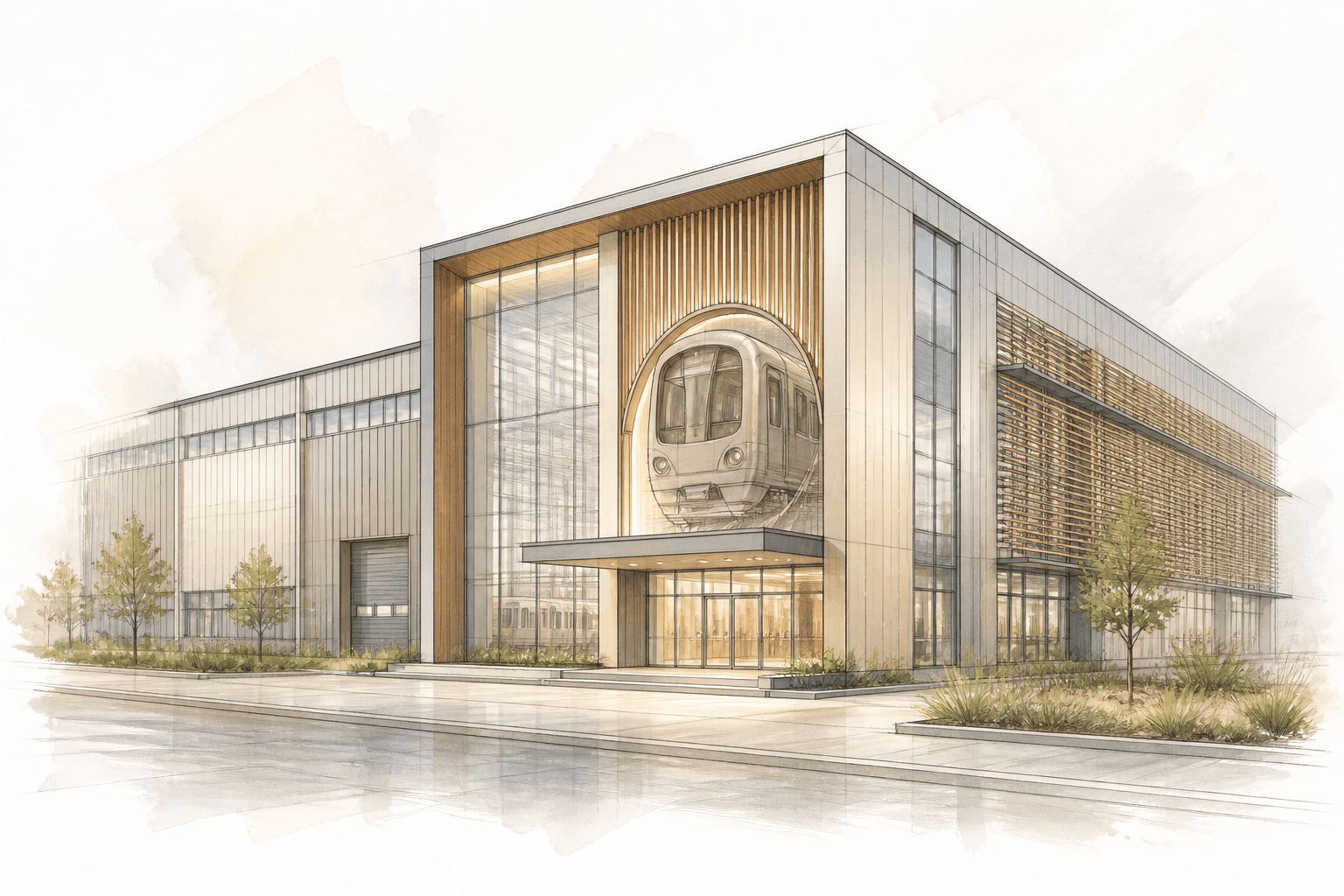
Metro Car Plant Financial Model
Description
A metro car plant is a large-scale industrial facility designed to manufacture rolling stock for urban transit systems. Unlike a generic manufacturing template, this financial model captures the multi-year production cycle from initial order to final commissioning, where a single contract may span 3–10 years with staged deliveries, retention payments, and performance guarantees tied to each train set. The revenue profile is driven by firm contracts, options for additional cars, and separate maintenance agreements — all modelled with adjustable timelines.
The model reflects the capital-intensive nature of the business: heavy upfront investment in a specialized plant with test tracks, paint shops, and automation lines. Equipment procurement often involves long-lead imported machinery requiring substantial pre-delivery payments, which the model schedules against the construction timeline. Financing structures allow for export credit agencies, multilateral loans, or equipment leasing, with separate interest and repayment logic for each tranche.
Localization requirements are a defining feature of metro car supply contracts. Many tenders mandate minimum local content, which the model handles through a dedicated localisation sheet — tracking the transition from completely knocked-down (CKD) assembly to domestic component manufacturing, applying different duty and tax treatments at each stage. The bill of materials splits between imported and local supplies, and the model dynamically adjusts landed costs as local suppliers come online.
Production is organized around car-body shells, bogies, propulsion, and interior fit-out. The model calculates direct material costs per car set based on configurable BOMs, applies learning curve coefficients to labour and overheads as serial production ramps up, and accounts for the cost of factory acceptance testing, transport, and on-site commissioning. Working capital management includes large raw material inventories, work-in-progress over long manufacturing cycles, and warranty retention receivables.
On the revenue side, the model supports milestone billing — down payments, factory inspection milestones, shipment milestones, and final acceptance — and handles the retention portion that remains unpaid until the defect liability period expires. A maintenance services module can be activated to project multi-decade overhaul and spare parts revenues, with separate pricing and cost structures.
The model also addresses the regulatory and procurement environment typical of publicly tendered metro car projects: bid bonds, performance bank guarantees, advance payment guarantees, and their effects on cash flow and balance sheet. Inflation indexation clauses (e.g., tied to steel, copper, and labour indices) are built into both revenue escalation and cost forecasting over the contract period.
Finally, a multi-currency environment is built into every sheet — contract pricing in local currency, imported components in EUR/USD, and local costs in domestic currency — allowing the user to stress-test net cash flows under different exchange rate scenarios and to model the cost of hedging strategies where applicable.
Modeling specifics
- Contract-based production schedule with unit-by-unit delivery timelines, enabling precise revenue recognition and cash flow matching per train set.
- Learning curve engine that automatically reduces labour and overhead cost per unit as cumulative production volume increases, preventing margin distortion in long series.
- Localization roadmap with stage-gates (CKD → semi-knocked-down → full local production) that adjust import duty, logistics, and supplier costs at each phase.
- Multi-currency cash flow model with configurable exchange rates, natural hedging offset (imported inputs vs. foreign currency revenue), and optional hedging instrument costs.
- Detailed capex waterfall for a multi-zone plant: land, civil works, industrial and test track equipment, with long-lead item pre-payment schedules and installation sequencing.
- Milestone-based billing logic including advance payment, factory acceptance, shipment, site acceptance, and retention release, mirroring standard FIDIC or similar contract terms.
- Warranty and maintenance obligation provisioning modelled as an actuarial-like fund, accumulating during the defect liability period and drawn down for corrective actions.
- Financing structure accommodating parallel tranches (ECA-covered loan, shareholder loans, leasing), each with distinct drawdown profiles, grace periods, and repayment terms.
- Inflation indexation of long-term contract revenues using cost-component baskets, rather than flat CPI, to align with real-world contract escalation clauses.
- Bank guarantee and performance bond tracker showing off-balance-sheet commitments and their cash collateral requirements across the project lifecycle.
- Tax model that handles import duties (including phased duty concessions under localisation), VAT refund timing, and corporate tax holidays if applicable.
What's included in the base version
- Investment sheet with phasing of capex by asset category and pre-operational expenses
- Multi-year production and delivery schedule with unit-level drivers
- Revenue model based on contracts, options, and milestone billing structure
- Direct cost module with BOM for imported and local components
- Labour and manufacturing overhead model with learning curve effects
- Operating expense (SG&A) projection
- Multi-currency cash flow statement with exchange rate sensitivity
- Profit-and-loss statement and balance sheet
- Debt and equity drawdown and repayment schedules
- Warranty provision and retention receivable tracking
- Key metrics dashboard (free cash flow, payback, coverage ratios)
- Scenario manager with toggles for production ramp, local content, and pricing
Common modeling mistakes
- Ignoring the learning curve in labour and overhead — unit cost is overstated by 15–25% at peak production, making the bid uncompetitive or invalidating the investment case.
- Treating revenue as lump-sum rather than milestone-based — cash inflows appear months ahead of reality, overstating IRR by 3–7 percentage points.
- Using a single blended exchange rate — unhedged exposure to currency swings can turn a 10% margin into a loss when local currency depreciates by 20–30% over the contract term.
- Underestimating working capital tied up in inventory for a low-volume, highly engineered product — total funding requirement underestimated by $X million (order-of-magnitude scale).
- Neglecting retention receivables and warranty costs — return on equity appears 5–10% higher than actual, because 10–15% of contract value may be tied up for 2–3 years after delivery.
- Omitting the cost of bid bonds, advance payment guarantees, and performance guarantees — pre-revenue liquidity gap is understated, potentially causing a cash shortfall before the first advance payment.
- Assuming immediate 100% local content without transition costs — margins inflated in early years and penalty risks under localisation commitments ignored.