Tram Plant Financial Model
Description
The model covers the full lifecycle of a tram manufacturing facility, from engineering design and prototype type-testing through series production, vehicle commissioning, delivery, and long-term after-sales support. It is structured for modern streetcars and light rail vehicles, accommodating various floor heights, multi-articulated configurations, and traction systems (overhead line, battery, or hybrid).
Production architecture is built around a paced assembly line with detailed cycle times per station for body shell welding, painting, bogie mounting, interior fitting, and static/dynamic testing. The bill of materials breaks down each tram into functional subsystems—car body, bogie, traction, auxiliary electrics, interiors, and control software—with make-or-buy differentiation and lead-time buffers for long-lead items such as traction converters and wheelsets.
Revenue recognition follows typical multi-year framework contracts with transit authorities or operators. Payment profiles are tied to engineering milestones, long-lead procurement, assembly completion, factory acceptance testing, delivery, and warranty retention release. The model also captures advance payments, liquidated damage penalties, and potential contract amendments for optional vehicle batches.
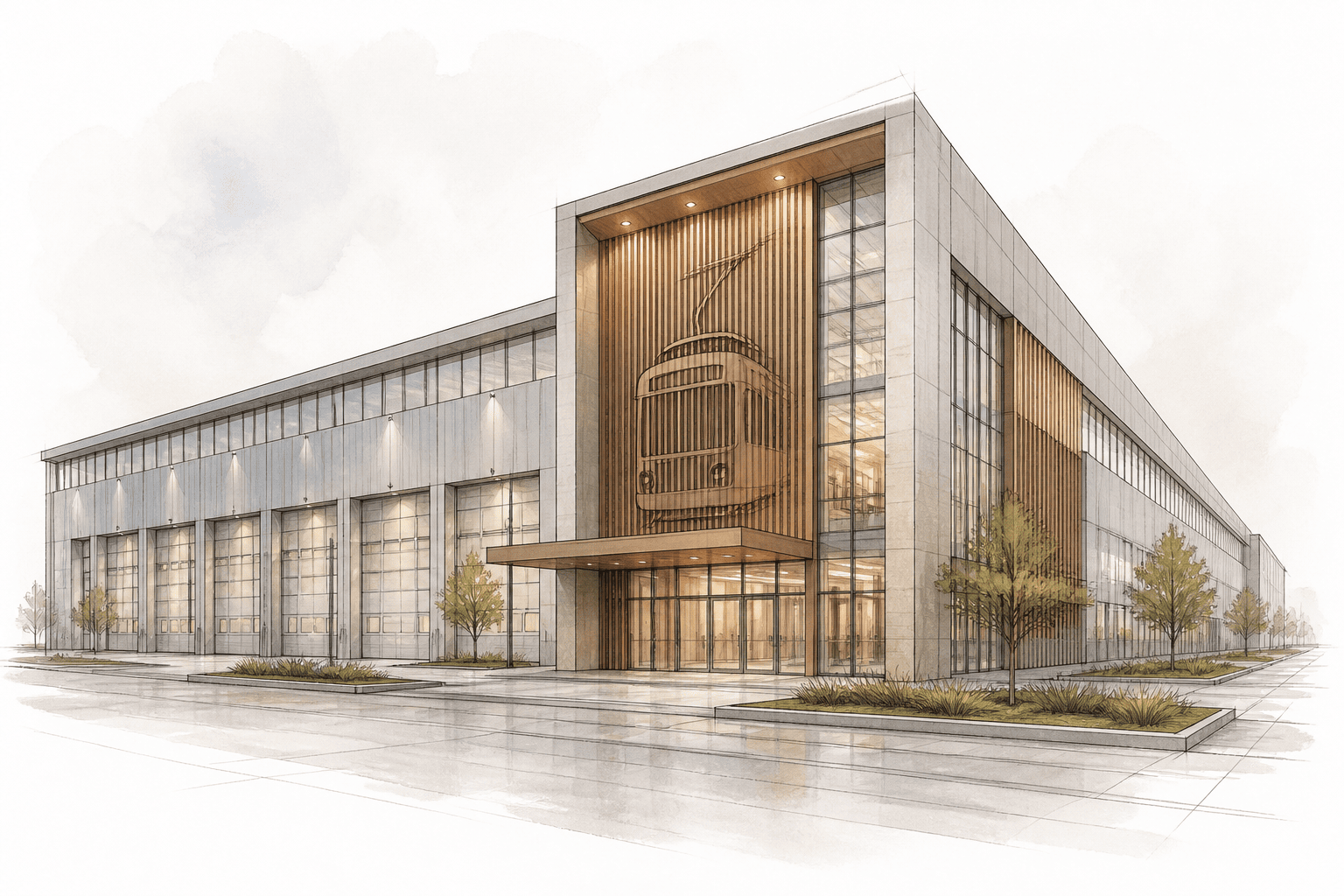
Capital expenditure scheduling includes civil works, specialized manufacturing equipment (robotic welding cells, CNC gantry mills, paint booths), a fully instrumented test track with overhead line or charging infrastructure, and delivery logistics. Each asset class is phased with interdependencies—for example, test track certification must precede series dynamic testing—and is linked to automatic depreciation.
Operating costs reflect a global supply chain with hundreds of components sourced in multiple currencies, direct labor by qualification tier, energy-intensive processes, warranty defect curves, and R&D for vehicle customization. Production overhead is allocated using activity-based costing, and work-in-progress valuation follows percentage-of-completion logic as trams move through assembly stations.
The model provides an indicative investment envelope to give a sense of the capital order of magnitude, though actual values will depend on plant capacity, localization depth, and specific site conditions. Financing options include senior debt, government grants tied to local content thresholds, and export credit agency support where applicable.
Modeling specifics
- Dynamic order book with automatic production slot allocation, sequencing constraints, and revenue recognition based on contract-specific milestone payments.
- Granular bill of materials organized by tram subsystem (bogie, body shell, traction, interiors) with make-or-buy logic and multi-currency materials costing.
- Progress payment engine mapping cash inflows to production stage gates: advance payment, long-lead procurement, body shell completion, painting, static test, dynamic test, delivery, and warranty retention release.
- Learning-curve algorithm adjusting direct labor input and material scrap rates by cumulative unit number during series production ramp-up.
- Time-phased warranty reserve model using defect probability curves per subsystem and claim severity distribution, rather than a flat percentage of revenue.
- Supplier contract management with lead-time buffers, multi-sourcing switches, and indexed forex pass-through mechanisms to isolate cost impact from currency shifts.
- CapEx phasing with precedence constraints (e.g., test track ready before dynamic testing; paint booth commissioned before body painting) and automatic depreciation commencement upon commissioning.
- Government incentive tracker for local content bonuses, per-vehicle subsidies with phase-out thresholds, and export credit insurance premium simulations.
- Pre-built scenario manager allowing simultaneous toggling of contract size, production cadence, localization depth, and debt/equity mix, with live recomputation of key metrics.
What's included in the base version
- Multi-year production plan with assembly line capacity allocation and unit-level progress tracking
- Personnel schedule by skill category (welders, assemblers, electricians, QA, engineering) and cost center
- Direct materials and purchased services calculation sourced from the BOM with waste and freight factors
- Capital expenditure register with phasing, asset classes, and depreciation (straight-line/declining)
- Revenue schedule disaggregated by contract and milestone, with retention receivable tracking
- Integrated monthly financial statements: Profit & Loss, Cash Flow, Balance Sheet
- Debt financing module with drawdown schedule, principal repayment, and interest capitalization during construction
- Corporate income tax, VAT/sales tax recovery, and deferred tax modeling
- Investment metrics dashboard: unlevered and levered NPV, IRR, payback, and debt service cover ratios
- Sensitivity tables on vehicle ASP, production rate, steel price, EUR/USD, and discount rate
Common modeling mistakes
- Assuming an instant production ramp-up to full design capacity without learning curve effects — inflates unit output by 20–30% in the first two series years and overstates early revenue.
- Ignoring retention payments and extended credit terms (typically 5–10% of the contract value held for 12–24 months after delivery) — overstates near-term cash balances and shortens payback by 1–2 years.
- Applying a single average EUR/USD exchange rate instead of reflecting the actual currency mix of multi-year supplier contracts — can distort gross margin by 8–12 percentage points over the project life.
- Modeling warranty cost as a simple fixed percentage of revenue without a time-phased defect curve — leads to under-reserving by 3–5% of vehicle cost, accumulating a hidden liability in the post-delivery period.
- Compressing or omitting the certification and type-testing phase (commonly 12–24 months before the first revenue-generating delivery) — front-loads revenue recognition and artificially boosts IRR by 5–8 percentage points.